For many homeowners, a backyard pool is a place for relaxation and recreation.
However, those seeking a rigorous swimming workout often find standard pools too short for uninterrupted laps.
Swim jet systems, often described as treadmills for swimmers, solve this problem by generating a powerful, adjustable current that allows you to swim in place.
This guide examines how these systems work, their benefits, costs, and ultimately helps you determine if this technology aligns with your fitness and lifestyle needs.
How Swim Jets Generate a Continuous Current
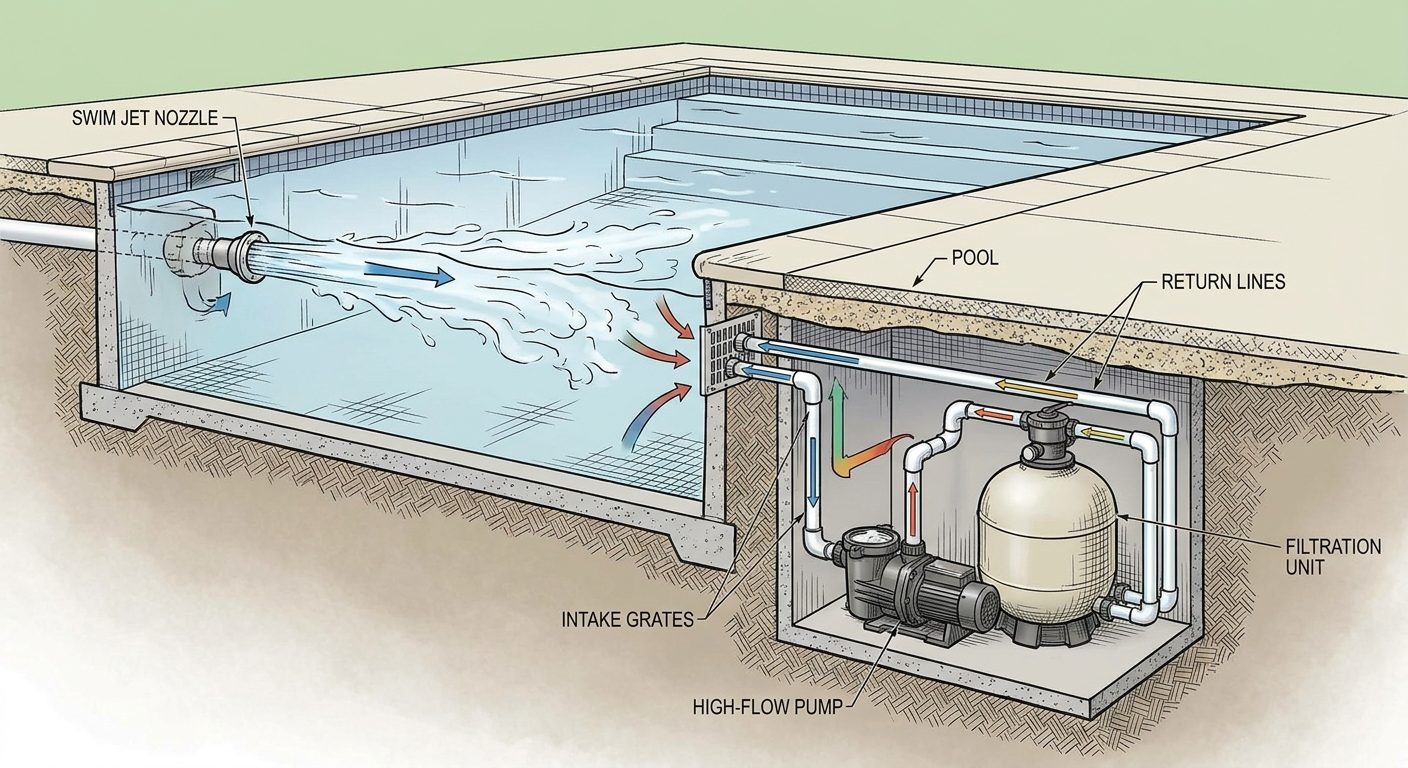
Swim jets operate by drawing pool water through intake ports and propelling it back through specialized directional nozzles at high velocity.
This creates a steady, wide stream of water that a swimmer can work against.
The core components include a pump motor, plumbing connections, and a control panel that allows users to adjust the flow rate from a gentle current to a challenging resistance exceeding 1,000 gallons per minute.
This continuous circulation effectively transforms any pool into an endless swimming environment.
Practical Benefits for Homeowners
Space Optimization. The most significant benefit is the ability to perform lap swimming in a compact pool. Systems can function effectively in pools as short as 12 to 15 feet, eliminating the need for a costly pool extension or a dedicated long lap pool.
Health and Fitness Versatility. Swim jets provide a low-impact, full-body workout that builds cardiovascular endurance and muscle strength without stressing the joints.
The adjustable resistance caters to everyone from beginners doing water aerobics to competitive athletes performing high-intensity interval training.
This also makes them valuable tools for physical therapy and rehabilitation.
Extended Swimming Season. When paired with a pool heater, swim jets can significantly extend the usable months of your pool. The constant circulation helps maintain consistent water temperature, allowing for comfortable training regardless of the outdoor weather.
Critical Factors to Evaluate Before Purchase
Flow Rate and Power. The intensity of the current is measured in gallons per minute (GPM) or cubic meters per hour (m³/h).
Higher flow rates generate stronger resistance, necessary for serious swimmers.
However, the design of the nozzle and the positioning of the jet are equally important for creating a comfortable, bubble-free stream that keeps the swimmer’s body properly elevated in the water.
Noise Levels. Pool machinery can be disruptive. Pump-based systems often generate considerable noise, which can detract from the tranquility of the backyard environment. Turbine-based systems operating underwater are typically much quieter. Visiting a showroom to hear a system operate is a recommended step.
Pool Compatibility and Size. Not all systems fit all pools.
In-ground systems are integrated during construction, while modular retrofits can be added to existing concrete, fiberglass, or vinyl pools.
Experts recommend a minimum pool length of approximately 13 to 14 feet to prevent the current from bouncing off the far wall and creating turbulence.
Automation and Control. Modern swim jets often include advanced control systems.
Wireless remote controls, smartphone apps, and programmable workout routines allow users to adjust the flow intensity dynamically.
This automation enhances the training experience, enabling interval training or gradual warm-ups at the touch of a button.
Understanding the Financial Investment
The cost of a swim jet system varies widely.
Entry-level portable or lower-power pump systems can start around $2,000.
High-performance, turbine-based systems designed for serious athletes, often installed as integrated units in new pools, can range from $15,000 to over $30,000.
Key factors influencing the price include the type of power source (pump vs. turbine), the number of jet outlets, the level of automation, and the complexity of the installation, particularly for existing pools requiring extensive plumbing and electrical work.
Making the Final Assessment on Value
Deciding whether a swim jet is a worthwhile addition hinges entirely on how you intend to use your pool.
For the casual swimmer, the investment may be difficult to justify compared to a simple fitness routine.
However, for dedicated fitness enthusiasts, triathletes, or those who use swimming as primary therapy, the convenience and consistency offered by a swim jet are unmatched.
It eliminates travel time to a community pool and provides unlimited swimming distance on demand.
While a swim jet cannot perfectly replicate the nuances of a large competition pool—such as flip turns and push-offs—it excels at providing a focused, uninterrupted cardiovascular workout.
The technology has matured significantly, with modern systems offering quieter operation, lower energy consumption, and stronger, more natural currents.
For many pool owners, are swim jets worth it depends on the balance between installation cost, long-term fitness benefits, and how regularly the system will actually be used.
Weighing the Pros and Cons
- Pros: Unlimited swimming distance, compact footprint, adjustable intensity for all fitness levels, low-impact exercise, potential to increase property value, extends pool usability.
- Cons: Significant initial investment, requires adequate pool space and depth, does not allow for competition-specific starts and turns, adds complexity to pool maintenance and energy consumption.
Conclusion
Swim jets represent a mature and effective solution for maximizing the fitness potential of a residential pool.
While the cost and installation requirements are considerable, the benefits of convenient, year-round, adjustable resistance swimming are compelling for the right user.
By thoroughly evaluating your swimming goals, pool characteristics, and budget, you can make an informed decision about whether this technology is a sound investment for your home and health.
